Bahasa Indonesia
 English
Benchmarking for Excellence: SPs UNY Conducts FGD Visit to SPs UNS on Human Resource and Institutional Development
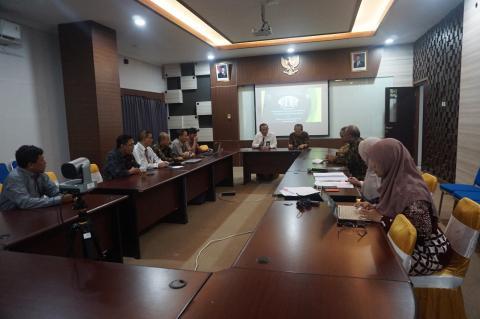
The Graduate School of Universitas Negeri Yogyakarta (SPs UNY) conducted a Focus Group Discussion (FGD) visit on Higher Education Human Resource and Institutional Development to the Graduate School of Universitas Sebelas Maret (SPs UNS) Surakarta on Thursday, 22 January 2026. The visit was part of a broader effort to strengthen institutional governance and human resource development within higher education.
The delegation was led by the Director of SPs UNY, Prof. Dr. Siswantoyo, M.Kes., AIFO., accompanied by the Coordinator of the Doctoral Program in Educational Sciences and the Coordinator of the Master's Program in Vocational and Technical Education (PTK). The SPs UNY team was warmly welcomed by the Dean of SPs UNS and the institution's leadership, particularly the Chair of the SPs UNS Academic Senate.
In his opening remarks, the Dean of SPs UNS noted that SPs UNS shares a relatively similar institutional profile with SPs UNY — both being former teacher training institutions (LPTK/ex-IKIP) that have since transformed into State Universities with Legal Entity status (PTN-BH). Regarding academic management, he explained that monodisciplinary study programs are administered by their respective faculties to ensure structured and sequential development. At present, SPs UNS concentrates its focus on managing six multidisciplinary study programs.
The Dean further underlined the critical role of the Graduate School's Academic Senate in supporting strategic decision-making. The Academic Senate serves in an advisory capacity to the Graduate School leadership across several key functions, including the development of multidisciplinary programs, the submission of proposals for new study programs, the academic promotion process for lecturers, and coordination with deans and relevant stakeholders on matters of faculty appointment, transfer, and promotion.
The FGD also extended into discussions on Income Generation (IG) development and the strengthening of institutional partnerships to support both academic and non-academic growth. SPs UNS representatives explained that the effective functioning of the Academic Senate is contingent upon a fundamental prerequisite — the presence of homebase lecturers at the graduate school level, particularly Professors whose primary academic affiliation is with the Graduate School.
On the subject of lecturer promotion mechanisms, it was explained that the assessment process is conducted through an integrated digital system. The Academic Credit Assessment (PAK) is carried out in stages by a designated evaluation team, with the results subsequently deliberated in an Academic Senate meeting before a formal recommendation is submitted to the Rector or university administration. The Deputy Dean for Non-Academic Affairs serves as the person in charge of overseeing the PAK process.
In terms of international graduate development and institutional networking, SPs UNS has established partnerships with a wide range of stakeholders, including the Central Government, Regional Governments, and the private sector, as part of its ongoing strategy for sustainable institutional strengthening.
Through this FGD visit, SPs UNY aimed to gain valuable insights and best practices in human resource management, the role of the Academic Senate, and institutional partnership development — all of which can be adapted to further enhance the quality of governance at the UNY Graduate School.


TEMUKAN KAMI